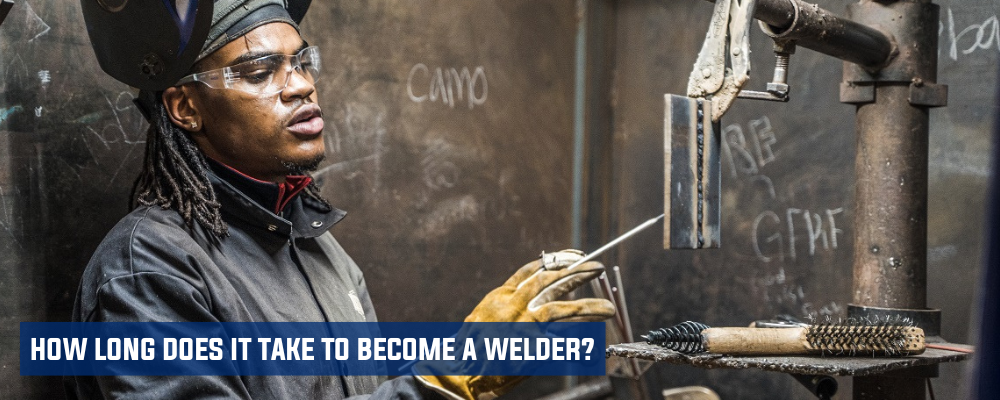
A welder is a skilled traders worker who joins or cuts metal by applying heat with hand-held or remotely controlled equipment. Part of the job of a welder is also to fill holes, indentations or seams. Welders work in industries like manufacturing, construction and shipbuilding.
Becoming a welder usually involves getting a high school degree (or equivalent), welder training and industry certifications. The time it takes to complete each of these steps can vary, depending on which welding career path you choose.
How Long Does it Take to Become a Welder?
How long it takes to become a welder generally depends on which educational route you select. For instance, an apprenticeship may take a few years to finish, whereas vocational school education can often be finished in less than a year. It is also important to note that some people begin welding training as early as high school, if a vocational program is offered at their school. Others might start their training at a vocational school with no prior experience. Here are some factors that impact the time it takes to become a welder.
High School/GED
Whether you choose on-the-job training or a vocational school, a high school diploma or its equivalent, like a GED certificate, is typically the minimum education required. If you’re a high school student interested in a welding career, you should focus on math, science, and shop classes. Keep in mind that it usually takes about four years to earn a high school diploma and about three months to get a GED certificate.
Welder Training
Training options for future welders include on-the-job training, welding training programs, vocational school, apprenticeships and community college. You can receive a certificate, diploma or associate degree at the end of their welder training. Welders-to-be are instructed in welding techniques, metallurgy, blueprint reading and safety procedures.
Learning the welding trade may take anywhere from a few months to a few years, depending on the kind of training a welder pursues. Some welders start as laborers, and earn on-the-job training that allows them to advance in the field without ever attending a formal vocational program. However, starting as a laborer and becoming a welder can take several years.
It’s also important to note that although some employers may be willing to hire inexperienced entry-level workers and train them on the job, many prefer to hire workers who already have training, credentials and certifications. That’s due in part because even entry-level workers with formal technical training still often have to receive several months of on-the-job training and in some cases, certifications, depending on their employer.
Welder Certifications
As part of their training, you may get certified in specific welding technologies. For example, Delta Technical College (DTC) certifies students in various SMAW, GTAW and FCAW techniques. Employers may also have internal certification programs, especially when they work with specific equipment.
A number of industry organizations offer certifications as well, such as the American Welding Society (AWS), the American Petroleum Institute (API) and American Society of Mechanical Engineers (ASME). Some certifications are available to you during the welding training or shortly thereafter, while others require a minimum amount of work experience.
How Long Do You Have to Go to School to Be a Welder?
While some choose to learn the trade on the job, many employers prefer candidates with formal training. The two main options for those who wish to enroll in welding training programs are vocational school or community college.
Vocational School
A skilled trades training program at a vocational school emphasizes welding skills. DTC’s hands-on welding program covers welding techniques, shop safety, pipefitting skills and blue print reading. Classes cover metal properties, cutting techniques, safety training, rigging, metallurgy and math. You can complete the welding program in seven months, and will receive a diploma upon graduation.
Community College
A community college welding program typically lasts two years, however, it may take longer to finish depending on class schedules. Upon completion, you will graduate with an associate degree. Welding programs at community colleges cover similar topics as vocational school programs, but you may also enroll in general education classes like English or History.
Interested in Learning More About Welding?
Fill out the form below to receive info about our career training programs.
What Are the Licensing Requirements for Welders?
Licensing requirements differ from state to state. In Mississippi, for example, you don’t need a license unless you work on public projects that cost $50,000 or more, or on private projects that cost $100,000 or more.
Start Your Journey to Become a Welder at DTC
Becoming a welder involves a number of steps: getting welding training, obtaining certifications and earning any necessary licenses. How much time you need for each step depends on factors like educational preferences, individual abilities and work requirements. Typically, attending a welder training program at a trade school is the fastest route to becoming an entry-level welder.
Interested in learning more about DTC’s welding training programs? Contact the Admissions Team to learn more.
SOURCES